I was first introduced to John Keats in my senior English class, I can’t recall anything regarding the unit but it seemed my English teacher was a fan of Keats’s work and decided to show us a letter he had sent to the love of his life, Fanny Brawne. If memory serves me correctly she projected it onto the screen and we read it amongst ourselves. Despite my brief stint as an avid reader, I had never read anything of that caliber, no multi-novel book series, no classic novel, and no famous speech captured so beautifully the essence of love as Keats did in a short letter to his beloved. As the class discussed I couldn’t help but be moved, tears streaming silently down my face.
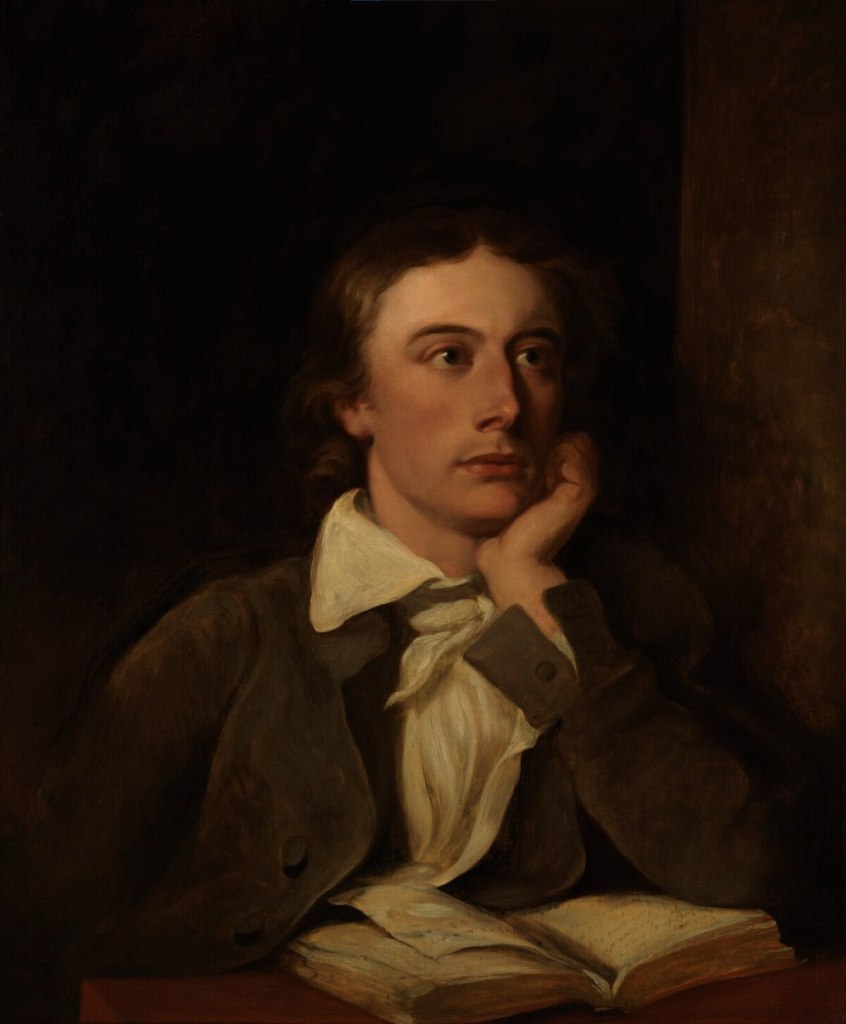
The story of Keats is a tragic one. He left behind a career in medicine to pursue his true passion, poetry. His publications were by most accounts failures and were at times heavily criticized by mainstream critics and despite that, he continued. In the last years of his life, he met Fanny Brawne who became the focus of his desires and a fountain of inspiration. Just as his love took grasp, death did too as he slowly succumbed to consumption or what is now known as tuberculosis, the same disease that took so many of his loved ones. Recommended by physicians and friends alike, Keats took to Rome to alleviate his symptoms, there he spent the last few months of his life, far away from home and his friends, far from the woman he loved. His death by no account was a peaceful and painless one, he was denied opium as he spent his waking moments coughing up blood, plagued by aches and sweats, his eventual autopsy revealing his lung had almost disintegrated. His love with Fanny was never consumated but some of his letters and notes survive to this day. Keats died at the age of 25, having only spent writing poetry for 6 years, he died by many accounts, including his own, a failure. Keats’ fame would grow posthumously becoming part of the English Literature canon and a key figure in the Romantic movement. As for Fanny, she mourned Keats for 6 years and after more than 12 years she eventually married.
To me, Keats was the purest poet to ever live, he who dedicated his short and narrow life so completely to the beauty and mysteries of love. Through his pain and suffering, through the love he had for all that was beautiful, through the love he had for one person he unveiled a world once invisible to me, a world where love so pure exists, a world where words can capture the essence of love. Because of Keats, I recognized the power letters and poems had as mediums for love, though my poetic skill is nowhere near as wonderful as Keats’s, I have no doubt every letter and every poem I ever wrote attempts to capture love as intense as the love Keats felt for Fanny. Nissa, I dedicate to you that very same letter which opened not just my eyes but my heart, and my favorite poem of his.
Letter
13 October, 1819
25 College Street
My dearest Girl,
This moment I have set myself to copy some verses out fair. I cannot proceed with any degree of content. I must write you a line or two and see if that will assist in dismissing you from my Mind for ever so short a time. Upon my Soul I can think of nothing else – The time is passed when I had power to advise and warn you again[s]t the unpromising morning of my Life – My love has made me selfish. I cannot exist without you – I am forgetful of every thing but seeing you again – my Life seems to stop there – I see no further. You have absorb’d me. I have a sensation at the present moment as though I was dissolving – I should be exquisitely miserable without the hope of soon seeing you. I should be afraid to separate myself far from you. My sweet Fanny, will your heart never change? My love, will it? I have no limit now to my love – You note came in just here – I cannot be happier away from you – ‘T is richer than an Argosy of Pearles. Do not threat me even in jest. I have been astonished that Men could die Martyrs for religion – I have shudder’d at it – I shudder no more – I could be martyr’d for my Religion – Love is my religion – I could die for that – I could die for you. My Creed is Love and you are its only tenet – You have ravish’d me away by a Power I cannot resist: and yet I could resist till I saw you; and even since I have seen you I have endeavoured often “to reason against the reasons of my Love.” I can do that no more – the pain would be too great – My Love is selfish – I cannot breathe without you.
Yours for ever
John Keats
Poem
To Fanny.
I cry your mercy—pity—love!—ay, love!
Merciful love that tantalises not
One-thoughted, never-wandering, guileless love,
Unmask’d, and being seen—without a blot!
O! let me have thee whole,—all—all—be mine!
That shape, that fairness, that sweet minor zest
Of love, your kiss,—those hands, those eyes divine,
That warm, white, lucent, million-pleasured breast,—
Yourself—your soul—in pity give me all,
Withhold no atom’s atom or I die,
Or living on, perhaps, your wretched thrall,
Forget, in the mist of idle misery,
Life’s purposes,—the palate of my mind
Losing its gust, and my ambition blind!
 At the Crossroads